Career Compounding: Why Careers Don't Grow Linearly (And What Actually Compounds)
Career compounding doesn't come from time or titles. Learn why most careers reset—and how systems create long-term career growth.
Career compounding is one of those ideas people nod at—but rarely experience.
Most careers look like they should compound. Time passes. Experience accumulates. Titles change. Yet for many people, each new opportunity still feels like a reset.
New resume. New explanations. New pressure.
If that sounds familiar, the problem isn’t effort or ambition. It’s that most careers are not set up to compound at all.
Why Career Compounding Rarely Happens by Accident
Career advice often assumes a simple model:
Work hard → gain experience → move forward.
But career compounding doesn’t come from time or effort alone. It comes from preserved value.
If the output of your work disappears once a project ends or a role changes, your career isn’t compounding—it’s restarting.
That’s why equally capable people can end up with wildly different trajectories over time.
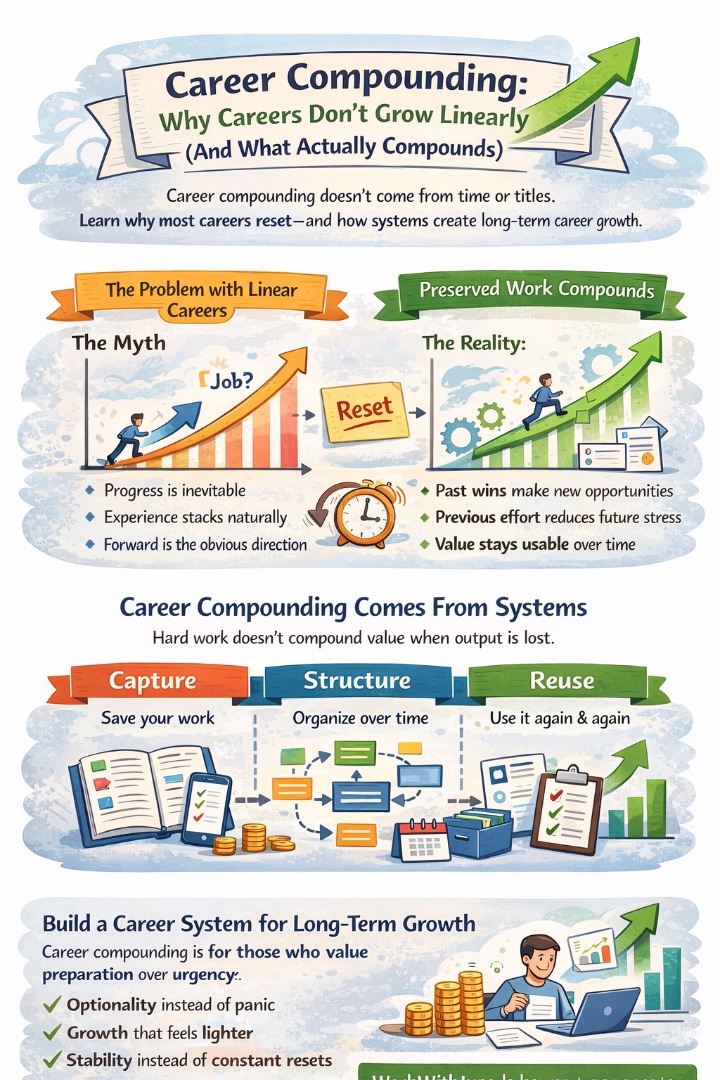
The Myth of Linear Career Growth
Linear career growth sounds reasonable:
- Each role builds on the last
- Experience stacks naturally
- Progress is inevitable
In practice, linear thinking hides a flaw.
It treats every career moment—job searches, reviews, promotions—as a standalone event. And standalone events don’t compound.
They reset.
What Career Compounding Actually Means
Career compounding works much like financial compounding.
In finance, growth accelerates when returns are reinvested. In careers, growth accelerates when past work reduces future effort.
Career compounding means:
- Past work makes future opportunities easier
- Previous effort reduces future stress
- Context, decisions, and impact stay usable over time
If you constantly have to reconstruct your own history, compounding isn’t happening.
Why Hard Work Alone Doesn’t Create Career Compounding
This is where many people get stuck.
They are working hard. They are producing value. But value that isn’t captured decays.
Think about how much of your work survives in a reusable form:
- Decisions you made under pressure
- Tradeoffs you navigated
- Impact you had behind the scenes
When that information lives only in memory, it fades. And when it fades, career compounding stops.
Career Compounding Comes From Systems, Not Roles
Titles don’t compound. Companies don’t compound. Even skills don’t reliably compound on their own.
Systems compound.
A career compounds when there’s a system that:
- Captures work as it happens
- Structures it over time
- Allows it to be reused across moments
Without that system, every new opportunity feels heavier than the last.
This is the same failure mode explored in Why Your Career Feels Chaotic (And Why It’s Not Your Fault)—chaos isn’t personal, it’s structural.
What Career Compounding Looks Like in Real Life
Career compounding doesn’t feel flashy. It feels calm.
It looks like:
- Less panic when opportunities appear
- Faster clarity in interviews and reviews
- Confidence rooted in evidence, not optimism
You stop relying on memory. You stop scrambling under deadlines. Your past work quietly supports you.
That’s compounding.
Why Most People Never Experience Career Compounding
Career compounding requires doing small, unglamorous work before it feels necessary.
Most people wait until:
- A job search forces reflection
- A review deadline creates pressure
- An opportunity exposes gaps
By then, compounding has already been delayed.
Systems reward preparation—not urgency.
Who Career Compounding Is Actually For
This way of thinking is for people who want:
- Optionality instead of panic
- Stability instead of constant resets
- Growth that feels lighter over time, not heavier
It’s not for shortcut-seekers or hustle panic.
Career compounding doesn’t promise speed. It promises durability.
A Question Worth Sitting With
If career compounding is working, the future feels easier—not harder.
So ask yourself:
Is my current career setup helping my past work carry me forward—or forcing me to start over again?
That answer tells you whether your career is compounding… or quietly resetting.
Want to build a career system that compounds over time? WorkWithJuno helps you capture achievements continuously and turn them into resumes, performance reviews, and career narratives when you need them.