Why Your Career Feels Chaotic (And Why It's Not Your Fault)
If your career feels chaotic, it's usually not personal. Learn why careers break down without systems—and how structure restores clarity.
If your career feels chaotic, it’s easy to assume you’re doing something wrong.
You might tell yourself you should be more confident, more prepared, or better at explaining your work. But for many people, career chaos has very little to do with effort or ability.
In reality, a career feels chaotic when it’s missing a system.
Why So Many Careers Feel Chaotic Under Pressure
Career chaos usually appears at predictable moments:
- When you suddenly need to update a resume
- When an unexpected opportunity appears
- When a performance review approaches
- When a job search stretches longer than expected
What’s frustrating is that many people in these moments are highly competent. They’ve done meaningful work. They’ve delivered results.
So why does everything feel unstable?
Because most careers are run without structure.
The Broken Mental Model: Careers as Linear Timelines
Most career advice assumes a simple model:
You get a job. You gain experience. You move forward.
This linear career model works only when nothing goes wrong.
Under pressure, it collapses.
Each resume update becomes a memory test. Each review becomes a scramble. Each job search feels like starting over.
That’s why a career can feel chaotic even when progress looks good on paper.
Why Smart People Still Feel Unprepared
Career chaos isn’t caused by lack of talent or ambition.
It’s caused by information loss over time.
Think about how much of your work actually exists in a usable form:
- Decisions you made under pressure
- Tradeoffs you navigated
- Problems you solved quietly
- Influence you had without formal authority
When this information isn’t captured, it disappears. Memory fades. Context erodes. Stress distorts recall.
That’s not a confidence issue. It’s a system failure.
The Reframe: Careers Are Systems, Not Timelines
Here’s the shift that reduces chaos:
A career is not a timeline of jobs. It’s a system that either compounds or breaks down over time.
In any system, outputs depend on inputs.
For careers, the most important inputs are:
- Captured work
- Documented decisions
- Preserved context
When those inputs exist, your career becomes calmer and more predictable. When they don’t, chaos fills the gap.
The Three Components of a Career System
To reduce career chaos, a system needs three parts.
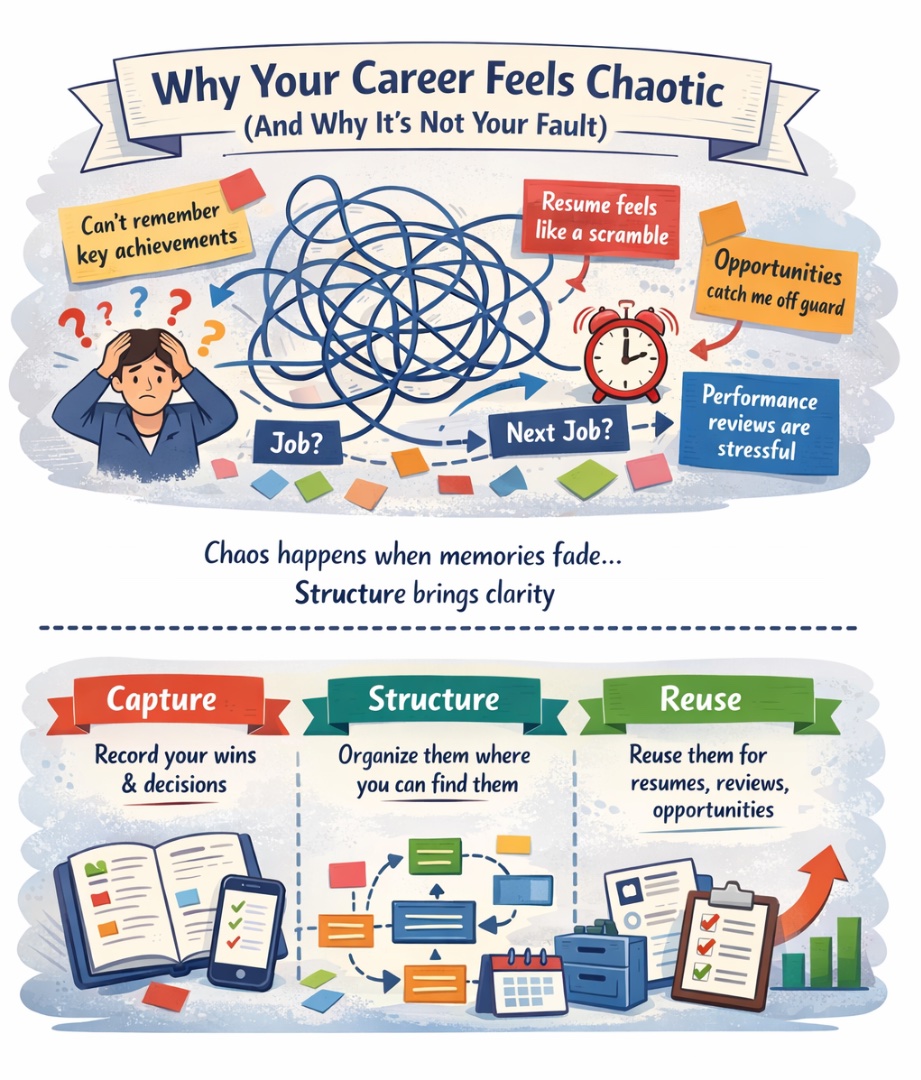
1. Capture
Work only compounds if it’s preserved.
Relying on memory guarantees loss. Capture means recording work as it happens—messy, incomplete, but real.
2. Structure
Captured work needs a place to live.
Without structure, documentation becomes another source of overwhelm. With structure, patterns emerge naturally over time.
3. Reuse
This is where stability appears.
The same captured work can support resumes, interviews, performance reviews, and promotions—if it exists in a reusable form.
This idea connects directly to how careers compound over time, where systems—not effort—create long-term momentum.
Why Most Career Advice Fails to Reduce Chaos
Traditional career advice assumes:
- You’ll remember your best work
- You’ll have time to reflect before it matters
- You’ll feel confident under pressure
Real life rarely works that way.
That’s why advice like “just tailor your resume” feels hollow when your career feels chaotic. It treats symptoms instead of structure.
Who This Way of Thinking Is For (And Not For)
This approach is for people who want:
- Less scrambling
- Fewer career resets
- Confidence grounded in evidence
- A career that compounds quietly
It’s not for shortcuts, hacks, or urgency-driven tactics.
Systems don’t promise speed. They promise stability.
Where Career Systems Reduce Chaos
Once you start thinking in systems, patterns become obvious:
- Job searches feel more manageable
- Performance reviews stop being surprises
- Promotions feel earned, not mysterious
- Opportunities stop catching you off guard
Not because you worked harder—but because your past work stayed available.
A Quiet Place to Start
You don’t need a new tool or a perfect process.
Just ask:
How much of my work exists somewhere I can actually reuse?
If the answer is “not much,” that’s normal. It’s also exactly where systems begin.
Want to build a career system that reduces chaos? WorkWithJuno helps you capture achievements continuously and turn them into resumes, performance reviews, and career narratives when you need them.