The Real Reason You Forget Your Best Work (And How to Stop It)
High performers forget their best work not because of memory, but timing. Learn why capture must happen first—interpretation comes later.
You know you’ve done good work.
You’ve delivered results. You’ve solved problems. You’ve made decisions that mattered. Yet when you look back—at a performance review, a promotion conversation, or a moment when you need to prove impact—some of your best work feels hazy or incomplete.
Not because it wasn’t important.
Because it was never captured when it was fresh.
If that sounds familiar, the problem isn’t your memory or your ability to recognize value. It’s that most people try to capture work after they understand its significance, and by then, the details have already started to fade.
Why High Performers Still Forget Their Best Work
Most people assume that if work is important, it will be remembered.
That assumption breaks down over time.
When you’re actively working on something, the context is immediate. You remember the constraints, the tradeoffs, the decisions that led to the outcome. But once a project ends or priorities shift, that context fades. What remains is a vague sense that you accomplished something, without the specifics that make it meaningful.
This isn’t a memory problem. It’s a timing problem.
Your work exists in two forms: the work itself (what you built, delivered, or changed) and the story of the work (why it mattered, how you navigated it, what you learned). Most careers only preserve the first. The second—the context, decisions, and reasoning—lives in memory, and memory decays predictably over time.
That’s why high performers still forget their best work. You’re not failing to recognize value. You’re trying to capture it after the moment has passed, and by then, the details that make it compelling have already started to disappear.
The Misbelief That Keeps People Stuck
The most common response to forgetting work is: wait until you understand its significance.
Wait until the project is complete. Wait until you see the impact. Wait until you can articulate why it mattered.
But that approach guarantees loss.
The real problem isn’t that you’re bad at recognizing value. It’s that you’re trying to capture work after you’ve interpreted its meaning, and interpretation takes time. By the time you understand why something mattered, the specific details—the constraints you navigated, the tradeoffs you made, the decisions that required judgment—have already started to fade.
Think about the last time you tried to remember a project from six months ago. You might recall the outcome, but do you remember the specific constraints you navigated? The tradeoffs you made? The decisions that seemed obvious at the time but required judgment in the moment?
Those details are what make work reusable. They’re also what disappears first.
Capture First, Interpret Later
Here’s the reframe:
Your ability to reuse your work doesn’t depend on understanding it perfectly. It depends on capturing it while it’s fresh.
When work is captured as it happens—not after it’s finished, not after you understand its significance, but while it’s active—you’re preserving the raw material. Interpretation can happen later. The details, context, and decisions are already there, waiting to be understood.
This doesn’t mean over-documenting everything or maintaining perfect records. It means creating a lightweight system that captures work as it happens, so that when you need to understand it later, the information exists—you’re just interpreting what’s already there, not trying to reconstruct what’s been forgotten.
Capture first, interpret later, because capture is time-sensitive. Interpretation is not.
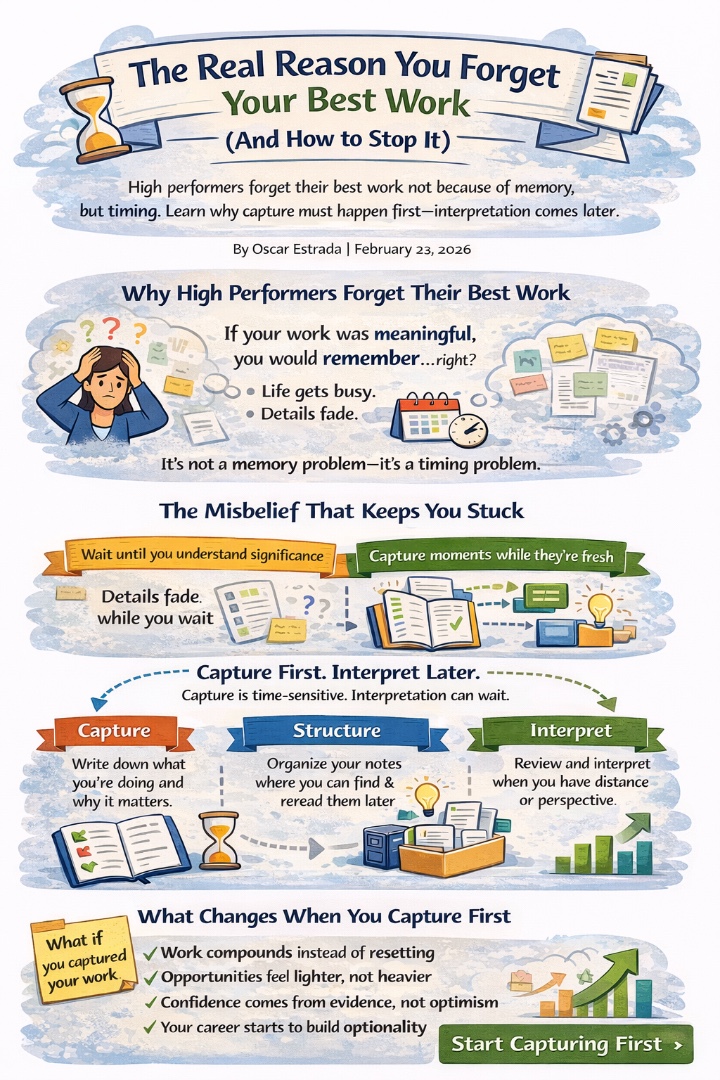
High performers don’t forget their best work because of memory—they forget because it wasn’t captured while fresh. A structured professional achievement log preserves context first, interpretation later.
This connects directly to how achievement capture reduces the struggle to explain your work—when work is documented systematically, explanation becomes retrieval, not reconstruction.
What Changes When You Capture First
When you shift from interpretation-first capture to capture-first thinking, several things change:
Work compounds instead of resetting.
Each project, role, or responsibility builds on the last. You’re not relearning how to articulate yourself every time context shifts. The captured work carries forward, and so does your ability to understand and reuse it.
Opportunities feel lighter, not heavier.
You’re not starting from zero every time. Past work is already captured and ready to interpret. Review prep becomes curation, not excavation.
Confidence comes from evidence, not optimism.
You know what you’ve done because you’ve been tracking it. There’s no guessing about impact or scrambling to remember specifics. The work speaks for itself because you’ve preserved it.
Your career starts to build optionality.
When work is captured continuously, you’re always prepared—not just for the next review or promotion, but for opportunities you haven’t seen yet. Optionality is built quietly, through consistent capture, not in moments of urgency.
This is what it means for work to become a reusable asset instead of a disappearing moment.
What Capture-First Actually Looks Like
Capture-first thinking doesn’t require complex tools or rigid processes.
It requires three things:
-
Capture — A way to record what you’re working on, why it matters, and what decisions you’re making as work happens (not after it’s over, not after you understand it, but while it’s active).
-
Structure — A consistent way to organize achievements, context, and outcomes so they’re easy to reference later, even if you don’t fully understand their significance yet.
-
Interpretation — The ability to revisit captured work later, when you have distance, perspective, or a specific need, and understand what it meant.
Most people skip the first two and try to brute-force the third. That’s why work always feels incomplete or forgotten. You’re trying to capture and interpret simultaneously, and both suffer. Capture is time-sensitive. Interpretation is not.
The system doesn’t need to be perfect. It just needs to exist.
For more on what actually counts as an achievement worth capturing, see What Actually Counts as a Career Achievement (Most People Miss This) (coming soon).
Why Most Advice About Remembering Work Fails
Traditional advice about remembering work assumes:
- You’ll recognize value when you see it
- You’ll have time to reflect before it matters
- You’ll remember the details when you need them
Real life rarely works that way.
That’s why advice like “just keep a brag book” feels hollow when you can’t remember what you did last quarter. It treats symptoms instead of structure. The real solution isn’t better memory or recognition—it’s better capture timing.
When work is captured as it happens, remembering becomes interpretation. And interpretation can happen anytime—not just when the work is fresh, but when you have distance, perspective, or a specific need.
Who This Way of Thinking Is For (And Not For)
This approach is for people who want:
- Their work to compound over time, not reset
- Optionality instead of panic when opportunities appear
- Growth that feels lighter over time, not heavier
- A career that builds quietly, through consistent capture
It’s not for people who:
- Want shortcuts or hacks that promise immediate results
- Prefer motivational energy over operational clarity
- Think capturing work is about confidence or recognition rather than timing
- Are looking for tips, tricks, or quick fixes
If you’re in the first group, capture-first thinking will feel like preparation. If you’re in the second, it will feel too slow.
That’s intentional.
A Question Worth Sitting With
Most people forget their best work because they try to capture it after they understand its significance.
The assumption is that important work will naturally be remembered. But without capture, important work just becomes vague memory. And memory decays predictably over time—not because you’re unprepared, but because memory isn’t designed to be a reliable storage system.
So here’s the question:
If you captured your work as it happened—before you fully understood its significance—what would feel different the next time you needed to prove impact?
That difference—between forgetting and remembering, between reconstruction and interpretation—is what this is about.
Not recognizing value better.
Not improving your memory.
Not getting better at reflection.
Creating a system that captures work while it’s fresh, so that when understanding is needed, the information already exists—waiting to be interpreted, not reconstructed.
That’s what it means for work to become leverage instead of a memory test.
Want to build a system that captures your work as it happens? WorkWithJuno helps you document achievements continuously and turn them into clear explanations when you need them.